503 Service Unavailable
What is HTTP 503 Service Unavailable?
Imagine you go to a restaurant, but it's super crowded and the staff is overwhel...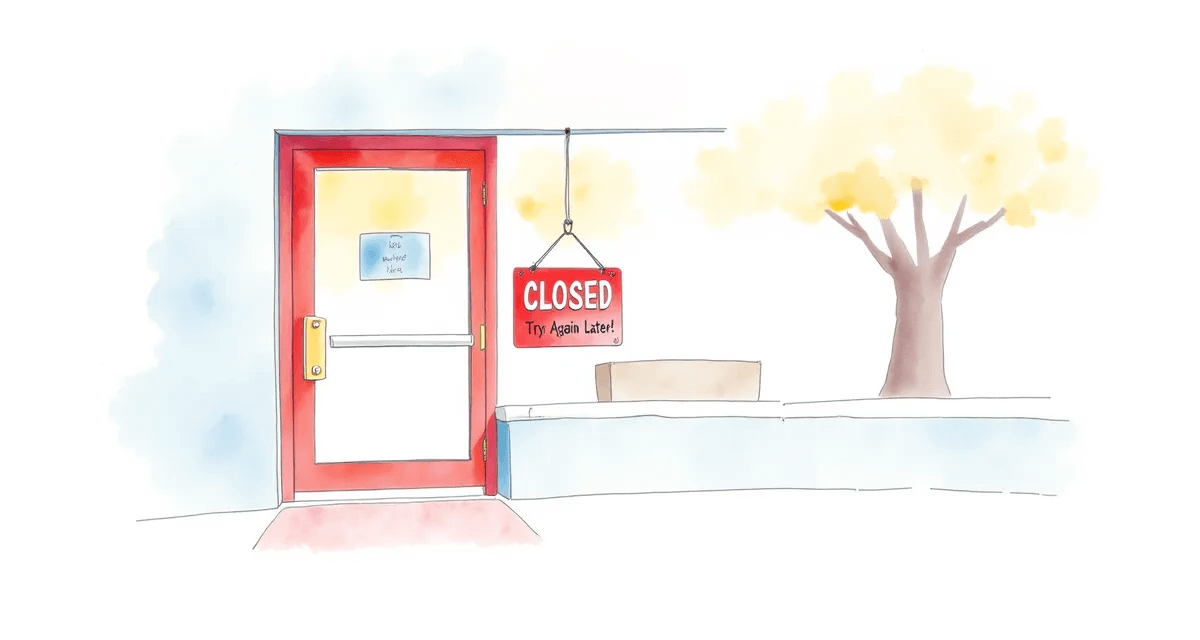
Explain Like I’m 3
You go to get ice cream, but there’s a sign on the door that says “Closed for cleaning! Come back in 30 minutes!” The ice cream shop isn’t broken - they’re just cleaning up right now and can’t serve you. But they told you when to come back! That’s what 503 means - the website can’t help you right now, but it will be able to help you soon. It’s just taking a little break!
Example: Your favorite playground has a sign: “Closed for painting. Open again tomorrow!” The playground isn’t gone forever - it’s just getting fixed up and you need to wait a bit!
Explain Like I’m 5
Imagine you go to a restaurant, but it’s super crowded and the staff is overwhelmed. The host says “We’re too busy to seat new customers right now. Can you come back in 15 minutes?” The restaurant isn’t broken or closed forever - they’re just handling too many people at once and need you to wait. That’s a 503 Service Unavailable - the server is too busy or doing maintenance and can’t help you right now, but it’s temporary. Come back soon and it should work!
Example: When the school cafeteria is so crowded they have to close the line temporarily and ask you to come back in 10 minutes after some people finish eating.
Jr. Developer
503 Service Unavailable indicates the server temporarily can’t handle requests. Unlike 500 Internal Server Error (unexpected problem), 503 is intentional and temporary - the server is either overloaded, in maintenance mode, or deliberately limiting traffic.
Key characteristics:
- Temporary condition: Expected to resolve soon
- Retry-After header: Should tell clients when to retry
- Intentional response: Server chose to return 503 (not a crash)
- Cacheable: With explicit Cache-Control headers
Common causes:
- Planned maintenance or deployments
- Server overload (too many concurrent requests)
- Circuit breaker triggered (protecting failing dependency)
- Load shedding (deliberately dropping requests)
- Database connection pool exhausted
- Graceful shutdown in progress
503 vs similar codes:
- 500: Unexpected error, usually needs debugging
- 503: Temporary unavailability, intentional
- 504: Gateway timeout (upstream service slow)
- 429: Too many requests from one client
- 503: Server-wide unavailability
Best practice: Always include Retry-After header indicating when clients should retry (seconds or HTTP date).
Code Example
// Express.js: Maintenance mode with 503const express = require('express');const app = express();
// Maintenance mode flaglet maintenanceMode = false;let maintenanceEndTime = null;
// Middleware to check maintenance modeapp.use((req, res, next) => {  if (maintenanceMode) {    const retryAfter = maintenanceEndTime      ? Math.ceil((maintenanceEndTime - Date.now()) / 1000)      : 3600; // 1 hour default
    res.status(503)      .set('Retry-After', retryAfter.toString())      .json({        error: 'Service Unavailable',        message: 'Server is currently in maintenance mode',        retry_after_seconds: retryAfter,        estimated_completion: maintenanceEndTime      });    return;  }  next();});
// Enable maintenance mode endpointapp.post('/admin/maintenance/enable', (req, res) => {  maintenanceMode = true;  maintenanceEndTime = Date.now() + (req.body.duration || 3600) * 1000;  res.json({ message: 'Maintenance mode enabled' });});
// Load shedding examplelet activeRequests = 0;const MAX_CONCURRENT_REQUESTS = 100;
app.use((req, res, next) => {  if (activeRequests >= MAX_CONCURRENT_REQUESTS) {    return res.status(503)      .set('Retry-After', '30') // 30 seconds      .json({        error: 'Service Unavailable',        message: 'Server is currently overloaded',        active_requests: activeRequests,        max_capacity: MAX_CONCURRENT_REQUESTS      });  }
  activeRequests++;  res.on('finish', () => activeRequests--);  next();});
// Circuit breaker exampleclass CircuitBreaker {  constructor() {    this.state = 'CLOSED'; // CLOSED, OPEN, HALF_OPEN    this.failureCount = 0;    this.threshold = 5;  }
  async execute(fn) {    if (this.state === 'OPEN') {      throw new Error('Circuit breaker is OPEN');    }
    try {      const result = await fn();      this.onSuccess();      return result;    } catch (err) {      this.onFailure();      throw err;    }  }
  onFailure() {    this.failureCou...
Crash Course
HTTP 503 Service Unavailable (RFC 9110 §15.6.4) signals temporary server inability to handle requests. Unlike 500 (unexpected errors), 503 is intentional, controlled, and temporary - a deliberate decision to reject requests to protect service health.
RFC 9110 Definition: “The 503 (Service Unavailable) status code indicates that the server is currently unable to handle the request due to a temporary overload or scheduled maintenance, which will likely be alleviated after some delay. The server MAY send a Retry-After header field to suggest an appropriate amount of time for the client to wait before retrying the request.”
Strategic Uses of 503:
-
Planned Maintenance
- Deployments and database migrations
- Infrastructure upgrades
- Scheduled downtime
- Include Retry-After with exact time
-
Overload Protection (Load Shedding)
- Too many concurrent requests
- Resource exhaustion (CPU, memory, connections)
- Deliberately drop requests to stay operational
- Protect from cascading failures
-
Circuit Breaker Pattern
- Downstream dependency failing
- Open circuit prevents calls to failing service
- Return 503 instead of attempting doomed requests
- Allows failing service time to recover
-
Graceful Shutdown
- Application shutting down
- Stop accepting new requests
- Finish processing current requests
- Signal load balancer to route elsewhere
-
Rate Limiting (Global)
- Entire service at capacity
- Different from 429 (per-client limit)
- Use 503 for system-wide limits
Retry-After Header:
Critical for 503 responses. Two formats:
- Delay in seconds:
Retry-After: 120(wait 2 minutes) - HTTP date:
Retry-After: Wed, 21 Oct 2025 07:28:00 GMT
Clients should honor this - retrying immediately wastes resources.
Load Shedding Strategies:
- Simple Threshold: Max concurrent requests
- Priority-Based: Serve critical requests, drop low-priority
- **Probabilist…
Code Example
// Production-grade 503 handling with multiple patternsconst express = require('express');const app = express();
// Health check stateconst healthState = {  isHealthy: true,  maintenanceMode: false,  circuitBreakers: {}};
// Maintenance mode managementclass MaintenanceManager {  constructor() {    this.enabled = false;    this.startTime = null;    this.endTime = null;    this.message = '';  }
  enable(durationSeconds, message) {    this.enabled = true;    this.startTime = new Date();    this.endTime = new Date(Date.now() + (durationSeconds * 1000));    this.message = message || 'Scheduled maintenance in progress';  }
  disable() {    this.enabled = false;    this.startTime = null;    this.endTime = null;    this.message = '';  }
  getRetryAfter() {    if (!this.endTime) return 3600; // 1 hour default    return Math.max(0, Math.ceil((this.endTime - Date.now()) / 1000));  }
  middleware() {    return (req, res, next) => {      if (this.enabled) {        res.status(503)          .set('Retry-After', this.getRetryAfter().toString())          .json({            error: 'Service Unavailable',            message: this.message,            maintenance: true,            start_time: this.startTime,            estimated_end: this.endTime,            retry_after_seconds: this.getRetryAfter()          });        return;      }      next();    };  }}
const maintenance = new MaintenanceManager();app.use(maintenance.middleware());
// Load shedding with metricsclass LoadShedder {  constructor(maxLoad) {    this.maxLoad = maxLoad;    this.currentLoad = 0;    this.droppedRequests = 0;    this.totalRequests = 0;  }
  middleware() {    return (req, res, next) => {      this.totalRequests++;
      if (this.currentLoad >= this.maxLoad) {        this.droppedRequests++;
        // Calculate backoff based on overload severity        const overloadFactor = this.currentLoad / this.maxLoad;        const retryAfter = Math.ceil(30 * overloadFactor);
        return res.status(503)          .set('Retry-After', retryAfter.toString())          .json({            error: 'Service Unavailable',            message: 'Server is currently overloaded',            current_load: this.currentLoad,            max_capacity: this.maxLoad,            retry_after_seconds: retryAfter          });      }
      this.currentLoad++;      res.on('finish', () => {        this.currentLoad--;      });
...
Deep Dive
HTTP 503 Service Unavailable is a cornerstone of resilient system design. Unlike failure states (500, 502, 504), 503 represents controlled, intentional unavailability - a system protecting itself and its dependencies through deliberate request rejection.
Theoretical Foundation:
503 embodies the principle of graceful degradation: better to serve some requests reliably than to attempt all requests and fail catastrophically. This aligns with queueing theory’s stability principle - systems have finite capacity, and attempting to exceed it causes throughput collapse.
RFC 9110 Specification (Section 15.6.4):
“The 503 (Service Unavailable) status code indicates that the server is currently unable to handle the request due to a temporary overload or scheduled maintenance, which will likely be alleviated after some delay.”
Key aspects:
- Temporary: Expected to resolve
- May send Retry-After: Client guidance
- Overload or maintenance: Both valid reasons
503 in Distributed Systems:
1. Load Shedding: Deliberately rejecting requests under load prevents cascading failures.
Little’s Law: L = λW (queue length = arrival rate × wait time)
When arrival rate exceeds service rate, queue grows unbounded. 503 provides backpressure, limiting arrival rate.
Shedding Strategies:
- Random: Drop X% of requests
- Priority-based: Critical requests proceed, low-priority dropped
- LIFO: Drop newest requests (oldest already waited)
- CoDel: Control Delay algorithm from network QoS
2. Circuit Breaker Pattern:
Protects failing dependencies. States:
- CLOSED: Normal operation
- OPEN: Failing, return 503 immediately
- HALF_OPEN: Testing recovery
Key parameters:
- Failure threshold: Consecutive failures before opening
- Timeout: How long to stay open
- Success threshold: Consecutive successes to close from half-open
Mathematical Model: Error rate E exceeds threshold T → circuit opens Time T_timeout elapses → half-open Success rate S > threshold S_t → close
3. Bulkhead Pattern:
Isolate resource pools. If pool A exhausted, return 503 for A but continue serving pool B.
4. Backpressure:
Propagate 503 upstream: Service C → Service B → Service A → Client
If C returns 503, B should return 503 (not absorb and fail).
Retry-After Semantics:
RFC 9110 defines two formats:
- Seconds:
Retry-After: 120 - HTTP-date:
Retry-After: Wed, 21 Oct 2025 07:28:00 GMT
Client Behavior:
- MUST NOT retry bef…
Code Example
// Enterprise-grade 503 management with advanced patternsconst express = require('express');const promClient = require('prom-client');
// Metricsconst http503Counter = new promClient.Counter({  name: 'http_503_total',  help: 'Total 503 responses',  labelNames: ['reason']});
const loadGauge = new promClient.Gauge({  name: 'server_load',  help: 'Current server load'});
/** * Advanced Load Shedding with Multiple Strategies */class AdaptiveLoadShedder {  constructor(options = {}) {    this.maxLoad = options.maxLoad || 100;    this.currentLoad = 0;    this.priorityTiers = options.priorityTiers || {      critical: 3,      high: 2,      normal: 1,      low: 0    };    this.shedStrategy = options.strategy || 'priority';    this.metrics = {      total: 0,      served: 0,      shed: new Map()    };  }
  shouldServe(request) {    this.metrics.total++;    const utilization = this.currentLoad / this.maxLoad;
    switch (this.shedStrategy) {      case 'threshold':        return this.thresholdStrategy(utilization);      case 'priority':        return this.priorityStrategy(request, utilization);      case 'probabilistic':        return this.probabilisticStrategy(utilization);      default:        return true;    }  }
  thresholdStrategy(utilization) {    return utilization < 1.0;  }
  priorityStrategy(request, utilization) {    const priority = request.priority || 1;    const threshold = 1.0 - (0.2 * priority); // Higher priority = higher threshold    return utilization < threshold;  }
  probabilisticStrategy(utilization) {    if (utilization < 0.8) return true;    const serveProb = Math.max(0, (1 - utilization) / 0.2);    return Math.random() < serveProb;  }
  middleware() {    return (req, res, next) => {      loadGauge.set(this.currentLoad);
      // Assign priority based on endpoint      req.priority = this.getRequestPriority(req);
      if (!this.shouldServe(req)) {        const retryAfter = this.calculateRetryAfter();        this.recordShed(req.priority);
        http503Counter.inc({ reason: 'load_shedding' });
        return res.status(503)          .set('Retry-After', retryAfter.toString())          .json({            error: 'Service Unavailable',            message: 'Server is currently overloaded',            reason: 'load_shedding',            current_load: this.currentLoad,            max_capacity: this.maxLoad,            utilization: `${(this.currentLoad / this.maxLoad * 100).toFixed(1)}%`,            retry_after_seconds: retryAfter,            request_priority: req.priority          });      }
      this.currentLoad++;      this.metrics.served++;
      res.on('finish', () => {        this.currentLoad--;      });
      next();    };  }
  getRequestPriority(req) {    // Critical endpoints    if (req.path.startsWith('/api/health')) return 3;    if (req.path.startsWith('/api/critical')) return 3;
    // Hi...
Frequently Asked Questions
What's the difference between 503 Service Unavailable and 500 Internal Server Error?
503 is intentional and temporary - the server deliberately can't handle requests right now (maintenance, overload, circuit breaker) but expects to recover. 500 is unexpected - something broke, and it's not clear when/if it'll be fixed. 503 should include Retry-After header; 500 typically doesn't. Use 503 for planned outages and load management, 500 for bugs/crashes.
Should I always include a Retry-After header with 503?
Yes, RFC 9110 says the server MAY send Retry-After, but you SHOULD always include it. It helps clients know when to retry and prevents retry storms. Provide either seconds (Retry-After: 120) or HTTP date. If you don't know exactly when service will recover, give a conservative estimate (e.g., 300 seconds).
How does Google treat 503 errors for SEO?
Google understands 503 means temporary unavailability and maintains your search rankings during short outages (<24 hours). Google respects Retry-After header and will recrawl later. Extended 503s (multiple days) may cause de-indexing. Always use 503 (not 404 or 500) for planned maintenance to preserve SEO rankings.
What's the difference between 503 Service Unavailable and 429 Too Many Requests?
429 is per-client rate limiting - one client sent too many requests and is being throttled individually. 503 is system-wide unavailability - the entire service is unavailable to everyone (overload, maintenance, circuit breaker). Use 429 for client-specific limits, 503 for server-wide capacity issues.
Can I cache 503 responses?
By default, 503 responses are NOT cacheable (unlike most 5xx codes) because they represent temporary conditions. However, you can make them cacheable with Cache-Control headers (e.g., Cache-Control: max-age=60 for maintenance page). This can reduce load during outages but be careful - caching extends the outage for cached clients.
Should I use 503 for features that aren't implemented yet?
It depends. If you plan to implement the feature soon and want to signal 'coming soon', 503 with Retry-After can work. However, 501 Not Implemented is often clearer for unimplemented features. Some APIs use 503 for features in development, others prefer 501. Document your choice clearly in API docs.
How should clients handle 503 responses?
Clients must: (1) Check Retry-After header and wait that long before retrying, (2) Implement exponential backoff if no Retry-After, (3) Add jitter to retry delays to prevent thundering herd, (4) Have a maximum retry limit (don't retry forever), (5) Consider alternative endpoints or cached data if available. Never retry immediately - that makes the problem worse.
Common Causes
- Planned maintenance or deployment in progress
- Server is overloaded with too many concurrent requests
- Circuit breaker triggered due to failing dependency
- Database connection pool exhausted
- Load shedding activated to protect system stability
- Graceful shutdown in progress (application restarting)
- Resource exhaustion (CPU, memory, disk)
- Dependency service unavailable (cascading failure)
- Rate limiting at infrastructure level (different from 429)
- Temporary network issues between services
- Configuration rollback or emergency changes
- DDoS attack causing deliberate request dropping
Implementation Guidance
- Check Retry-After header and wait specified time before retrying
- For planned maintenance: Wait for maintenance window to complete
- For overload: Implement exponential backoff with jitter, reduce request rate
- Check service status page or monitoring dashboards
- If persistent: Contact server administrators or check social media for updates
- Implement client-side fallbacks (cached data, degraded functionality)
- Monitor health check endpoints for service recovery
- Don’t retry immediately - respect Retry-After to avoid making problem worse
- If building server: Add capacity (scale horizontally or vertically)
- If building server: Implement proper load shedding and circuit breakers
- If building server: Optimize slow endpoints causing overload
- Consider alternative API endpoints or mirror servers if available